Planning a Pregnancy? Get Info About Carrier Screening Here.
By Margaret Erpelding, CGC,
Certified Genetic Counselor
 What is carrier screening?
Carrier screening is a genetic test that determines if you are a carrier of an inherited (genetic) condition. Being a carrier means that you have a change in a gene that makes it not work the same. Carriers normally do not have symptoms, but their children can be at risk if the child’s other parent is also a carrier.
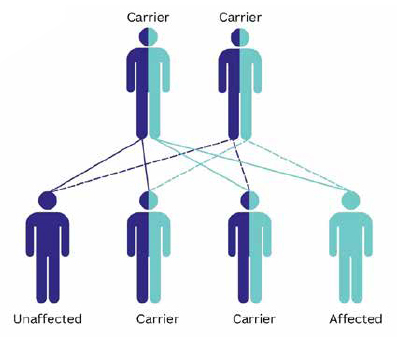
Carrier screening typically looks for conditions that are known as autosomal recessive, meaning that you need two nonfunctional copies of the gene to have the disease. We are all born with two copies of each gene, one from each parent. Someone who is a carrier has one functioning copy and one nonfunctioning copy. The function copy is enough to prevent that person from having symptoms. There often is not any family history of the recessive condition which is why carrier screening is recommended for everyone wanting to have children.

It is important to know that carrier screening can help you make decisions and achieve a healthy pregnancy, but it is not possible to screen for all conditions. Some genetic conditions happen spontaneously or are new in an egg or sperm which is not tested for on carrier screening.
What kinds of conditions can be inherited?
There are different options for the number of conditions screened for. You can discuss with your provider if you want to be more selective and look at just a few genes or if you want more information and can look at up to 500 genes. The most common conditions tested for are sickle cell anemia, cystic fibrosis, thalassemia, and more.
The American College of Medical Genetics and Genomics (ACMG) recommends that every pregnant person is offered carrier screening for conditions with a carrier frequency of ≥1/200. This means that about 0.5% of the population would be a carrier of that condition. The American College of Obstetricians and Gynecologists (ACOG) recommends that every pregnant person is offered carrier screening for conditions with a carrier frequency of ≥1/100; this means that about 1% of the population would be a carrier for that condition.
When should I have carrier screening done?
The best time to get carrier screening done is before pregnancy. This gives you the most options in your pregnancy planning. However, carrier screening can be done at any time before or during pregnancy. You only need to complete carrier screening once because your DNA does not change with time. If you have had carrier screening in the past you do not need to complete it again, unless you want to look at more genes.
What if I am a carrier?
We are all probably carriers for some genetic conditions and carriers do not normally have symptoms. If you are a carrier your partner should also get tested. If two people who are carriers for the same recessive genetic condition have a child, there is a 1 in 4 chance that the pregnancy would be affected. If your partner is not a carrier the pregnancy is unlikely to be affected.
With this knowledge, individuals can explore options like diagnostic testing during pregnancy or fertility options before pregnancy such as in-vitro fertilization. They can also learn about necessary treatment and care for a child with the condition or start treatment earlier.
You can discuss your genetic test results with our genetic counselor to decide what testing and options are right for you.
Topics
Share this page:
About the Author
Margaret Erpelding, CGC, Certified Genetic Counselor
 As a Certified Genetic Counselor, Margaret specializes in reproductive, prenatal, and cancer genetics. She brings a strong background in research and patient-centered counseling, offering personalized guidance to individuals and families as they navigate complex genetic information.
Her expertise includes supporting patients through pregnancy planning, understanding abnormal screening results, and evaluating family history of genetic conditions. Margaret’s compassionate and clear approach empowers patients to make informed decisions about genetic testing and their healthcare journey.